
Life Beyond Our Planet: Exploring Habitable Exoplanets

Life Beyond Our Planet_ Exploring Habitable Exoplanets - Brooklyn Shank
ABSTRACT
Background:
The search for extraterrestrial life has become one of the most important questions in modern astronomy. Thousands of exoplanets have been discovered, many of which may have conditions suitable for life, increasing scientific interest in determining whether Earth is unique or one of many habitable worlds.
Methods:
This literature review examined research articles found through Google Scholar using search terms related to extraterrestrial life, astrobiology, and exoplanet discoveries. Original research articles published after 2012 were reviewed to summarize scientific knowledge about potentially habitable exoplanets and the search for life beyond Earth.
Results:
Published research shows that only a small percentage of known exoplanets lie within the habitable zone of their stars, but the large number of planets in the galaxy suggests that billions of potentially habitable worlds may exist. Planetary mass, orbital period, stellar mass, and orbital distance all influence a planet’s habitability and help scientists identify planets for future study.
Discussion:
Although no direct evidence of extraterrestrial life has been found, current research shows that many exoplanets may hold conditions that could support life. Continued improvements in telescopes and detection methods are needed to expand our understanding of habitable worlds and bring scientists closer to answering whether life exists beyond Earth.
INTRODUCTION
Scientists have been looking for extraterrestrial life for over 100 years. Humanity has long placed great importance on exploring the possibility of life beyond Earth. Some people even argue that this urge to look outside of our planet and discover alien life is directly related to our past on Earth. Although there is little scientific evidence to support this idea [1], it raises one of the most fundamental questions in science: Are we alone in the universe? The search for exoplanets (planets revolving around other stars) started in the early 1990s when astronomers Aleksander Wolszczan and Dale Frail detected planets orbiting a rapidly spinning dead star called a pulsar [2]. This discovery marked the beginning of modern exoplanet research and led to the discovery of thousands of additional exoplanets. Astronomers have confirmed approximately 6,000 exoplanets [3]. Based on these discoveries and that a galaxy like the Milky Way may contain one trillion stars, it is possible that each galaxy contains about one trillion exoplanets. Even if only a small fraction are potentially habitable, this could still represent a large number of potentially habitable worlds [4,5]. With this information, it is hard not to think there has to be some sort of life out there. Fermi’s paradox concerns the apparent lack of evidence for extraterrestrial technological civilizations despite the large number of stars and planets. Proposed explanations include the possibility that technological civilizations are difficult to detect or choose not to communicate [6].
Although the concept of extraterrestrial life is not a problem in our world, it is important to learn about what is around us and if there are other living organisms like us. Future astronauts and astronomers learn about exoplanets in hopes of communicating with other life forms and possibly finding other places for organisms on Earth to live on. Ultimately, whether life exists beyond Earth remains unanswered, but ongoing discoveries continue to expand our understanding of exoplanets and the possibility of extraterrestrial life. This paper explored the question of whether life exists beyond Earth by examining exoplanet discoveries, the search for habitable worlds, and the scientific efforts to detect extraterrestrial life.
METHODS
This is a literature review paper about the search for extraterrestrial life. The research articles were found using Google Scholar. The key search terms included: is there life outside of Earth, astrobiology, and discoveries of life outside of Earth. These articles were original research papers published after the year 2012 that focused on specific discoveries about possible life beyond Earth and the amazing questions that arose from these explorations. After conducting research, multiple scholarly articles were reviewed and the most relevant sources were included in this paper.
RESULTS
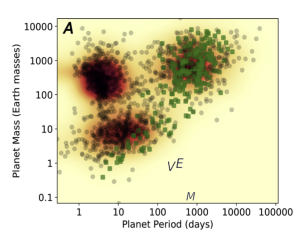
Figure 1. Reproduction of Hill et al. [4], their Figure 5. Distribution of exoplanets by orbital period and planetary mass. The graph plots planetary mass (in Earth masses) against orbital period (in days) on logarithmic scales. Colored regions represent the number density of detected exoplanets, while individual points show observed planets from different transit and radial-velocity methods. The labels VE and M indicate the approximate locations of Venus and Mercury, respectively, for comparison with known exoplanet populations [4].
In Figure 1, we see the distribution of exoplanets by orbital period and planetary mass. The graph plots planetary mass (in Earth masses) against orbital period (in days) on logarithmic scales. Colored regions represent the density of detected exoplanets, while individual points show observed planets from different detection methods. The labels VE and M indicate the approximate locations of Venus and Mercury, respectively, for comparison with known exoplanet populations. This image compares all the known habitable-zone planets and identifies trends of planetary mass and orbital period [3,4]. As shown, there are very big highlighted parts where habitable-zone planets are between 100 and 1000 times the mass of the Earth and have an orbital period of closer to five days. These planets spin very fast as they orbit around the sun. There is another highlighted section right below where the exoplanets are about 1-10 times the mass of the Earth and have an orbital period of about 10 days. These exoplanets are particularly interesting because of their place in the habitable-zone and their size is around the same as Earth. The final cluster of exoplanets in this graph is closer to the top right. These exoplanets are about 100-10000 times the mass of the Earth and rotate in about 1000 days. These bodies are what many call “super Earths” because they are much bigger and orbit much slower than what we experience on Earth. Scientists observe these clusters of exoplanets to identify patterns in their masses and the number of days they take to orbit their stars.
Another thing to note about Figure 1, is that potentially habitable planets occupy only a small part of all exoplanets. Even though only a small percentage of exoplanets appear to have potentially habitable conditions, there are still many possible worlds where life could exist. The figure also shows how astronomers have discovered only a small fraction of the habitable-zone, Earth-like exoplanets that likely exist. These planets often have longer orbitable periods than the average exoplanet and are generally larger and more massive. While there are lots of planets in the habitable-zone of stars, many of these do not resemble Earth at all. There are many examples of exoplanets in the habitable-zone that are made of gas and are a lot larger than our Earth. We still do not know if our planet and life on Earth are the rule or the exception, but by studying these discovered exoplanets, scientists can gain a better understanding of what other habitable-zone exoplanets may look like.
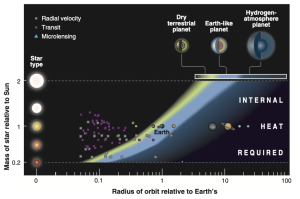
Figure 2. Reproduction of Seager [8], their Figure 2. Relationship between stellar mass and orbital distance for known exoplanets. The shaded region represents the habitable zone, where planets may receive enough energy to support liquid water. Colors within the habitable zone indicate the potential for different planetary environments, ranging from dry terrestrial planets to Earth-like planets and hydrogen-atmosphere planets. Symbols represent exoplanets discovered using the radial velocity, transit, and microlensing detection methods [8].
Figure 2 explores the relationship between stellar mass and orbital distance for known exoplanets. The shaded region represents the habitable zone, where planets may receive enough energy to support liquid water. Colors within the habitable zone indicate the potential for different planetary environments, ranging from dry terrestrial planets to Earth-like planets and hydrogen-atmosphere planets. Symbols represent exoplanets discovered using the radial velocity, transit, and microlensing detection methods [8]. This image shows how the habitable zone changes depending on the type of planet and atmosphere it has. The x-axis represents the planet’s orbital distance from the Sun in perms of AU (Astronomical Units); the y-axis represents the mass of the host star compared to the Sun. The yellow region stands for dry terrestrial planets that contain very little water while the dark blue region represents exoplanets with thick hydrogen-rich atmospheres. The light blue area is meant to symbolize the traditional habitable zone, Earth-like planets with nitrogen, carbon dioxide, and water-vapor atmospheres are mainly found here [8]. Because of current detection methods, most exoplanets discovered are located very close to their star [8,9]. Habitability is more than just the distance from the Sun, it depends on the size, mass, and atmosphere of the planet and its star. While the search for exoplanets is to look for Earth-like planets and learn more about our universe, scientists look for clues such as water, strong atmospheres, and important chemicals to discover life outside of Earth [8,9].
DISCUSSION
Overall, the results suggest that many exoplanets could have the right conditions to support life, but there is still no direct proof that life exists beyond Earth [6,8]. Finding planets in the habitable zone is only the first step to finding extraterrestrial life. A planet also needs the right atmosphere, temperature, and other conditions before it can be considered a good place for life to thrive [8]. However, even if a planet has the right environment for organisms to survive in, there is still a chance that life has not had enough time or resources to develop on the exoplanet. Though there are many restrictions for the environment scientists know life to thrive in, there are so many exoplanets that it is certainly possible to find a different form of extraterrestrial organisms on another planet.
Though most of these suspected exoplanets have not been found or discovered yet, I was surprised at how many bodies were found with conditions that could resemble Earth. Even though only a small percentage of exoplanets appear to have potentially habitable conditions, there are still many possible worlds where life could exist. With these results, it is hard not to think of how great the odds are that there is, in fact, life outside of our planet.
As stated previously, an exoplanet does not need to be within the habitable zone to support life . In addition, the likelihood of habitability depends not only on the planet’s distance from its star but also on its size and mass, which affect its ability to retain an atmosphere, regulate surface temperatures, and sustain conditions that could support life [8]. It is shown in Figure 1 that there are not many exoplanets with the same size and mass as Earth [7]. Additionally, there could be gas exoplanets composed of elements such as hydrogen and helium that are in the habitable zone and are the same size as Earth. This information can be useful for future research by helping identify which exoplanets should be studied more closely with new telescopes and technologies [7,9]. As more planets are discovered and better observations become available, it may become easier to detect possible signs of life. Ultimately, this paper shows that the search for life beyond Earth is still ongoing, but every discovery helps us understand where life could exist and brings us one step closer to answering whether we are alone in the universe [1,3,8].
References
- Schneider J. Philosophical issues in the search for extraterrestrial life and intelligence. International Journal of Astrobiology. 2013;12(3):259–62.
- Ho CSK. Into the radius valley. Astronomy & Geophysics. 2024;65(1):1.14–1.18.
- Akeson RL, Chen X, Ciardi D, Crane M, Good J, Harbut M, et al. The NASA Exoplanet Archive: Data and Tools for Exoplanet Research. Publications of the Astronomical Society of the Pacific. 2013;125(930):989–99.
- Hill ML, Bott K, Dalba PA, Fetherolf T, Kane SR, Kopparapu R, et al. A Catalog of Habitable Zone Exoplanets. The Astronomical Journal. 2023;165(2):34.
- Petigura EA, Howard AW, Marcy GW. Prevalence of Earth-size planets orbiting Sun-like stars. Proceedings of the National Academy of Sciences. 2013;110(48).
- Crawford IA, Schulze-Makuch D. Is the apparent absence of extraterrestrial technological civilizations down to the zoo hypothesis or nothing? Nature Astronomy. 2023;8(1):44–49.
- Ji JH, Li HT, Zhang JB, Fang L, Li D, Wang S, et al. CHES: A space-borne astrometric mission for the detection of habitable planets of the nearby solar-type stars. Research in Astronomy and Astrophysics. 2022;22:072003.
- Seager S. Exoplanet Habitability. Science. 2013;340(6132):577–81.
- Robinson TD, Salvador A. Exploring and Validating Exoplanet Atmospheric Retrievals with Solar System Analog Observations. The Planetary Science Journal. 2023;4(1):10.


